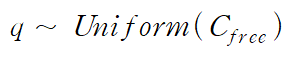
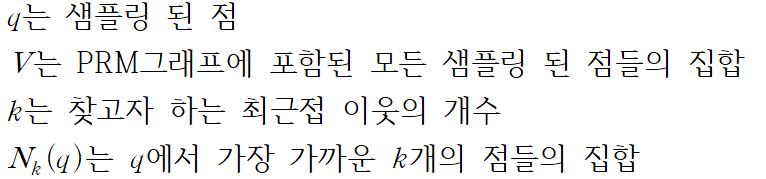
샘플링 방식은 uniform random , gaussian , bridge test 등이 존재한다.
충돌 검사를 통해서 장애물 내부에 위치한 샘플은 폐기한다.
1-2. 노드 연결
각 샘플을 인접한 이웃 노드들과 연결한다. 이웃은 주로 knn or r-nearst를 사용한다.
연결된 경로가 충돌이 없는지 검사도 해야함
1-3. 로드맵 생성 roadmap creation
2. 쿼리 단계
2-1. 시작 지점과 목표지점을 샘플링 된 로드맵에 연결한다.
2-2. 그래프 탐색으로 최적 경로 찾는다.
Pseudo code

def sample_Free( space , num_samples ):
	samples = []
    while len( samples ) < num_samples:
    	q = random_point( space )
        if not is_in_obstacle( q ):
        	samples.append( q )
    return samples

def connect_nodes( samples , k=5 )
	G = nx.Graph()
    for q in samples:
    	G.add_node( q )
        neighbors = find_k_nearest( q , samples , k )
        for neighbor in neighbors:
        	if collision_free( q , neighbor ):
            G.add_edge( q , neighbor , weight=distance( q , neighbor ) )
    return G


samples = sample_free(space, 1000)
roadmap = connect_nodes(samples)
path = nx.shortest_path(roadmap, source=start, target=goal, weight='weight')
import random
import math
import networkx as nx
import matplotlib.pyplot as plt

# 자유공간에서 점을 생성한다.
def random_sampling( space ):
    x_min , x_max , y_min , y_max = space # 탐색 공간의 경계정의
    return ( random.uniform(x_min,x_max) , random.uniform(y_min,y_max) )


 # 두 점 간의 거리를 계산
def distance( p1 , p2 ):
    return math.hypot( p1[0] - p2[0] , p1[1] - p2[1] )


# 충돌하는지 검사하는 함수.
def collision( point , obstacles ):
    x , y = point # 점의 좌표를 분리시킴
    for ( ox , oy , radius ) in obstacles: # 각 장애물의 중심과 반지름을 가져옴
        if math.hypot( ox - x , oy - y ) <= radius: # 점이 장애물 내부에 존재시 True를 반환. 즉, 충돌하는 경우
            return True
    return False # 충돌이 없는경우.


def collision_checking( p1 , p2 , obstacles , step_size=0.1 ):
    dist = distance( p1 , p2 )
    if dist == 0:
        return True
    steps = max( 1 , int( dist / step_size ) )
    for i in range( steps + 1 ):
        x = p1[0] + (p2[0] - p1[0]) * i / steps
        y = p1[1] + (p2[1] - p1[1]) * i / steps
        if collision( (x,y) , obstacles ):
            return False
    return True


def configuration_space_free( space , obstacles , num_samples ):
    free_nodes = [] # 충돌하지 않는 노드를 저장할 리스트
    while len( free_nodes ) < num_samples:
        q = random_sampling(space) # 랜덤 생성
        if not collision( q , obstacles): # 충돌하지 않으면 추가.
            free_nodes.append(q)
    return free_nodes


 def knn( point , samples , k ):
    samples = sorted( samples , key=lambda s: distance( point , s ) )
    return samples[ 1 : k+1 ] # 자신을 제외한 제일 근접한 k개의 노드만 반환


def connect_nodes( samples , obstacles , k=5 ):
    G = nx.Graph()
    for q in samples:
        G.add_node( q )
        neighbors = knn( q , samples , k )
        for neighbor in neighbors:
            if collision_checking( q , neighbor , obstacles ):
                G.add_edge( q , neighbor , weight=distance( q , neighbor ) )
    return G
# 시각화 함수
def plot_prm(G, start, goal, obstacles):
    plt.figure(figsize=(10, 10))  # 그래프 크기 설정

    # 장애물 그리기
    for (ox, oy, r) in obstacles:
        circle = plt.Circle((ox, oy), r, color='gray')  # 원형 장애물 생성
        plt.gca().add_patch(circle)  # 그래프에 추가

    # 노드 및 간선 그리기
    for (u, v) in G.edges():
        plt.plot([u[0], v[0]], [u[1], v[1]], 'b-', linewidth=0.5)  # 간선 표시
    for node in G.nodes():
        plt.plot(node[0], node[1], 'ro', markersize=3)  # 노드 표시

    # 시작점과 목표점 표시
    plt.plot(start[0], start[1], 'go', markersize=10, label='Start')  # 시작점 (녹색)
    plt.plot(goal[0], goal[1], 'mo', markersize=10, label='Goal')  # 목표점 (자홍색)
    plt.legend()  # 범례 추가
    plt.grid()  # 격자 표시
    plt.show()  # 그래프 출력
space = (0, 100, 0, 100)
obstacles = [(30, 30, 10), (60, 60, 15), (70, 20, 8)]

start = ( 5 , 5 )
goal = (95, 95)

samples = configuration_space_free(space, obstacles, 500)  # 자유 공간에서 500개의 샘플 생성
samples += [start, goal]  # 시작점과 목표점도 샘플에 추가

roadmap = connect_nodes(samples, obstacles, k=10)

try:
    # 시작점과 목표점 간 최단 경로 탐색
    path = nx.shortest_path(roadmap, source=start, target=goal, weight='weight')
except nx.NetworkXNoPath:
    path = []  # 경로가 없을 경우 빈 리스트 반환

# 결과 시각화
plot_prm(roadmap, start, goal, obstacles)  # 로드맵 시각화

# 경로 표시 (옵션)
if path:
    plt.figure(figsize=(10, 10))  # 그래프 크기 설정
    for (u, v) in roadmap.edges():
        plt.plot([u[0], v[0]], [u[1], v[1]], 'b-', linewidth=0.5)  # 로드맵의 간선 표시
    for node in roadmap.nodes():
        plt.plot(node[0], node[1], 'ro', markersize=3)  # 노드 표시
    plt.plot(start[0], start[1], 'go', markersize=10)  # 시작점 표시
    plt.plot(goal[0], goal[1], 'mo', markersize=10)  # 목표점 표시

    # 최단 경로 표시
    path_x, path_y = zip(*path)
    plt.plot(path_x, path_y, 'g-', linewidth=2, label='Path')  # 최단 경로를 초록색 선으로 표시

    plt.legend()  # 범례 표시
    plt.grid()  # 격자 표시
    plt.show()  # 그래프 출력