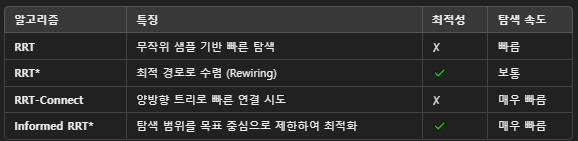
RRT (Rapidly-Exploring Random Tree)란?
- 고차원 상태 공간에서 빠르게 탐색할 수 있도록 설계된 샘플 기반 탐색 알고리즘.
- 특히 비선형 시스템의 경로 계획을 위해서 개발됨
- 핵심 아이디어
- 무작위 샘플링으로 빠르게 넓은 공간을 커버하고, 이를 기반으로 트리를 확장해서 경로를 찾는 방식
- 이론적 성질
- 1. 완전성 probabilistic completeness
- rrt는 확률적 완전성을 가진다. 이는 탐색 가능한 경로가 존재할 경우, 무한히 많은 샘플을 생성하면 결국에는 그 경로를 찾게 된다는 것을 의미
- 2. 최적성
- rrt는 최적 경로를 보장하지 않는다. 이를 보완하기 위해서 등장한 것이 RRT* 이다.
- 1. 완전성 probabilistic completeness
- 장점
- 트리의 샘플링이 진행됨에 따라서 탐색 공간을 균등하게 커버한다.
- n개의 노드가 존재시, 탐색 속도는 O( n log n )에 근접한다.
- 트리의 샘플링이 진행됨에 따라서 탐색 공간을 균등하게 커버한다.
- 단점
- 탐색 공간이 커질수록 샘플수가 기하급수적으로 증가한다. 그래서 이럴때는 guided sampling을 사용.
RRT (Rapidly-Exploring Random Tree)의 수학적 정의
- 상태 공간 state space
- 로봇의 모든 가능한 상태를 나타내는 공간이다.
- 즉, 자유공간안에서 시작점에서 목표까지 연속적으로 연결하는 경로를 찾는 문제
- 로봇의 모든 가능한 상태를 나타내는 공간이다.

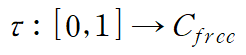
- 경로는 연속함수이며 아래와 같이 나타낸다.
- τ(0)은 시작점이며 τ(1)은 목표점이다.
RRT (Rapidly-Exploring Random Tree)의 작동 원리
- RRT는 트리를 점진적으로 확장하여 목표 지점에 도달하는 구조이다.
- 1. 랜덤 샘플링 random sampling ( 그림 1 참고 )
- 탐색 공간 C에서 무작위 샘플 q rand를 생성한다.
이는 탐색 공간을 고르게 커버하기 위해서 중요하다.
- 탐색 공간 C에서 무작위 샘플 q rand를 생성한다.

- 2. 최근접 노드 탐색 nearest neighbor search ( 그림 2 참고 )
- 기존 트리의 노드중 q rand에 가장 가까운 노드인 q near를 찾는다.
- 보통은 유클리드 거리를 탐색한다.
- 기존 트리의 노드중 q rand에 가장 가까운 노드인 q near를 찾는다.


- 3. 트리 확장 tree expansion ( 그림 3 참고 )
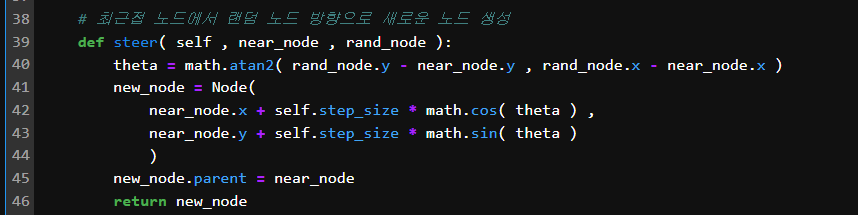
- 최근접 노드 q near에서 q rand방향으로 일정한 거리만큼 이동하여, 새로운 노드 q new를 생성함.


- 4. q near와 q new를 연결하는 선분이 C obs와 충동하는지 확인. 충돌이 없다면 트리에 추가함.
- 장애물과 노드간의 충돌 여부를 확인가기 위해서 유클리드 거리의 제곱을사용한다.
- 이는 점과 원의 중심간의 거리가 원의 radius보다 작거나 같은 경우를 의미하며, 이경우에는 노드가 원 안에 존재함을 의미.
- 장애물과 노드간의 충돌 여부를 확인가기 위해서 유클리드 거리의 제곱을사용한다.

- 5. 목표 근접 확인
- q new가 목표지점인 q goal에 충분히 가까워지면 탐색을 종료함.
그림1
- 왜 일정확률로 목표지점을 샘플링하나??
- RRT는 무작위 샘플링 기반으로 트리를 확장하는데, 목표 지점 근처로 확장하지 않으면 경로를 찾는데 오랜 시간이 걸릴수있다. 그래서 목표지점을 샘플링하면 트리가 목표지점 방향으로 성장해서 빠르게 수렴할 가능성이 높아진다.
- 무작위 샘플링만 한다면 탐색이 지나치게 불규칙 해지며, 목표로 가는 효율적인 경로를 찾기가 어려울수있다.
반대로 목표지점만 샘플링하면 장애물 회피가 어려워질수있다.
==> 그래서 탐색과 수렴 사이의 균형을 맞춰야함- 확률 높을수록 속도는 빠르나 장애물 회피 부족
- 확률 낮을수록 속도는 느리나 탐색을 잘할수있다.
- 무작위 샘플링만 한다면 탐색이 지나치게 불규칙 해지며, 목표로 가는 효율적인 경로를 찾기가 어려울수있다.
- RRT는 무작위 샘플링 기반으로 트리를 확장하는데, 목표 지점 근처로 확장하지 않으면 경로를 찾는데 오랜 시간이 걸릴수있다. 그래서 목표지점을 샘플링하면 트리가 목표지점 방향으로 성장해서 빠르게 수렴할 가능성이 높아진다.


그림2

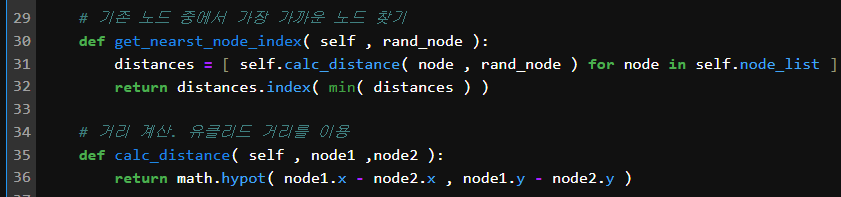
그림3
import math
import random
import matplotlib.pyplot as plt

# 노드 클래스
class Node:
    def __init__( self , x , y ):
        self.x = x
        self.y = y
        self.parent = None

class RRT:
    def __init__( self , start , goal , obstacle_list , rand_area , max_iter=500 , step_size=5.0 , goal_sample_rate=0.05 , goal_radius=5.0 ):
        self.start = Node( start[0] , start[1] ) # 시작 노드
        self.goal = Node( goal[0] , goal[1] ) # 목표 노드
        self.obstacle_list = obstacle_list # 장애물 목록 ( x , y , radius )
        self.rand_area = rand_area # 샘플링이 가능한 범위 ( min , max )
        self.max_iter = max_iter # 최대 반복 횟수
        self.step_size = step_size # 한번에 확장하는 거리
        self.goal_sample_rate = goal_sample_rate # 목표지점을 샘플링할 확률
        self.goal_radius = goal_radius # 목표 반경 (목표 도달 조건을 완화)
        self.node_list = [ self.start ] # 트리의 초기 노드 리스트 ( 시작 노드 포함 )

    # 탐색 공간에서 무작위 샘플 q를 생성한다.
    def get_random_node( self ):
        rand_x = random.uniform( self.rand_area[0] , self.rand_area[1] ) # 맵 사이즈 범위 내에서 랜덤한 숫자 발생
        rand_y = random.uniform( self.rand_area[0] , self.rand_area[1] )
        return Node( rand_x , rand_y )

    # 기존 노드 중에서 가장 가까운 노드 찾기
    def get_nearest_node_index( self , rand_node ):
        distances = [ self.calc_distance( node , rand_node ) for node in self.node_list ]
        return distances.index( min( distances ) )

    # 거리 계산. 유클리드 거리를 이용
    def calc_distance( self , node1 ,node2 ):
        return math.hypot( node1.x - node2.x , node1.y - node2.y )

    # 최근접 노드에서 랜덤 노드 방향으로 새로운 노드 생성
    def steer( self , near_node , rand_node ):
        theta = math.atan2( rand_node.y - near_node.y , rand_node.x - near_node.x )
        new_node = Node(
            near_node.x + self.step_size * math.cos( theta ) ,
            near_node.y + self.step_size * math.sin( theta )
            )
        new_node.parent = near_node
        return new_node

    # 충돌 검사 함수 : 장애물과의 충돌 여부 확인
    def is_collision_free( self , node ):
        for ( ox , oy , size ) in self.obstacle_list:
            # 유클리드 거리의 제곱을 계산하는 방정식이다.
            if ( ox - node.x)**2 + (oy - node.y )**2 <= size**2:
                return False # 충돌 있음
        return True # 충돌 없음

    def generate_final_path( self , goal_node ):
        path = [ (goal_node.x , goal_node.y ) ]
        node = goal_node
        while node.parent is not None:
            node = node.parent
            path.append( (node.x , node.y) )
        return path[ : : -1 ] # 경로를 역순으로 반환

    def planning( self ):
        for i in range( self.max_iter ):
            # 1. 랜덤 샘플링.  탐색공간C에서 무작위 샘플 q rand 를 생성한다.
            if random.random() < self.goal_sample_rate:
                q_rand = self.goal # 목표 지점으로 샘플링
            else:
                q_rand = self.get_random_node()

            # 2. 최근접 노드 탐색. 기존 트리의 노드중 q rand에 가장 가까운 노드인 q near을 찾는다.
            q_near_index = self.get_nearest_node_index( q_rand )
            q_near = self.node_list[ q_near_index ]

            # 3. 트리 확장. 최근접 노드 q near에서 q rand 방향으로 일정한 거리만큼 이동해서 새로운 q new를 생성함.
            q_new = self.steer( q_near , q_rand )

            # 4. 충돌하는지 확인. 충돌이 없다면 트리에 추가.
            if self.is_collision_free( q_new ):
                self.node_list.append( q_new )

            # 5. q new가 목표지점인 q goal에 가까워지면 탐색을 종료
            if self.calc_distance( q_new , self.goal ) <= self.goal_radius:
                return self.generate_final_path( q_new )
        return None
# 시각화 함수 정의
def draw_rrt(rrt, path=None):
plt.figure(figsize=(10, 10))
plt.grid(True)
# 장애물 그리기 (빨간 원)
for (ox, oy, size) in rrt.obstacle_list:
circle = plt.Circle((ox, oy), size, color='r')
plt.gca().add_patch(circle)
# RRT 트리 시각화 (초록색 선)
for node in rrt.node_list:
if node.parent:
plt.plot([node.x, node.parent.x], [node.y, node.parent.y], '-g')
# 최종 경로 시각화 (파란색 선)
if path:
path_x, path_y = zip(*path)
plt.plot(path_x, path_y, '-b', linewidth=2)
# 시작점과 목표점 표시
plt.plot(rrt.start.x, rrt.start.y, "ro", markersize=8, label='Start')
plt.plot(rrt.goal.x, rrt.goal.y, "bo", markersize=8, label='Goal')
plt.legend()
plt.show()
if __name__ == '__main__':
start = (0, 0)
goal = (90, 90)
obstacle_list = [(30, 30, 10), (60, 60, 10), (70, 20, 8)] # 장애물 (x, y, radius)
rand_area = (0, 100) # 샘플링 가능한 범위
# RRT 알고리즘 실행
rrt = RRT(start, goal, obstacle_list, rand_area)
path = rrt.planning()
# 결과 시각화
draw_rrt(rrt, path)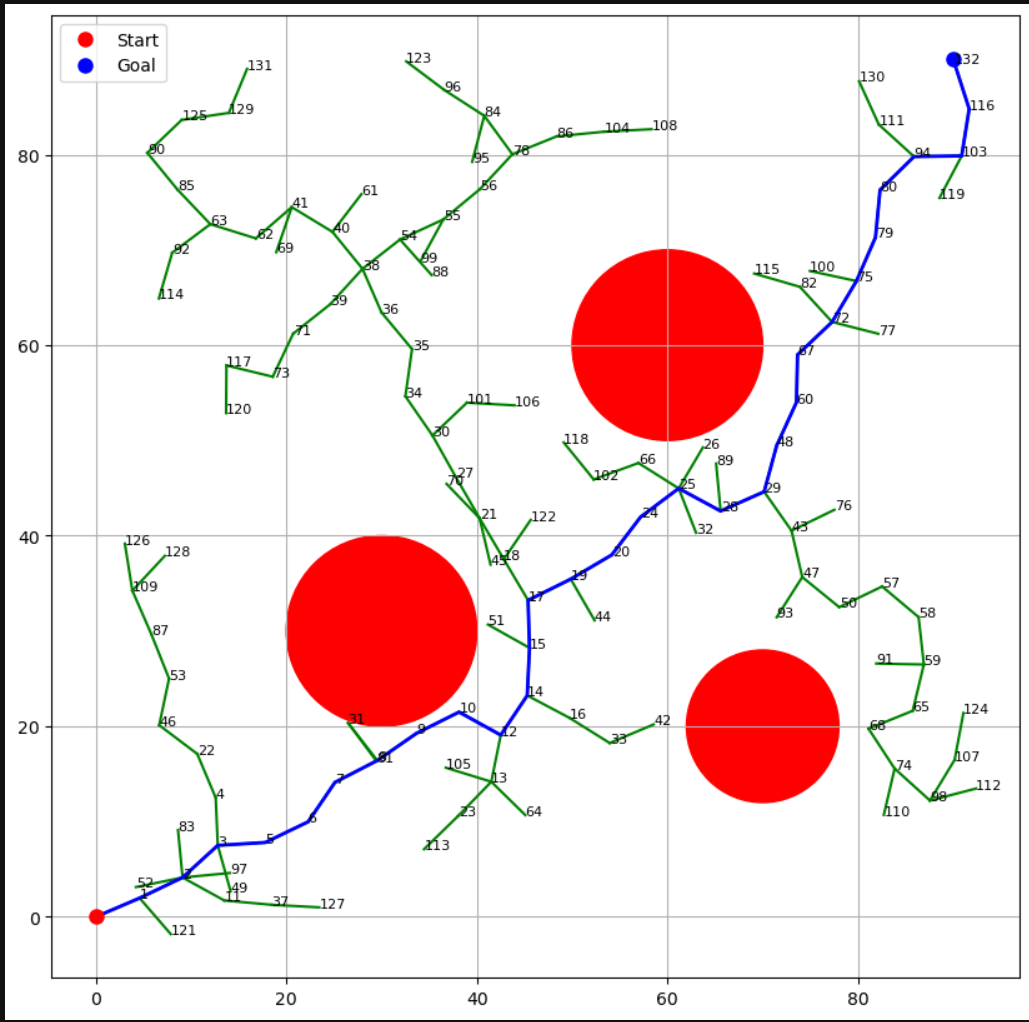
import random
import math
import matplotlib.pyplot as plt
import time

class Map2D:
    def __init__( self , width=10 , height=10 ):
        self.width = width
        self.height = height
        self.obstacles = [ (2, 10, 3, 2) , (6,0,7,8,) ]
    def is_in_obstacle( self , x , y ):
        for ( x_min , y_min , x_max , y_max ) in self.obstacles:
            if( x_min <= x_max) and ( y_min <= y_max ):
                if ( x_min <= x <= x_max ) and ( y_min <= y <= y_max ):
                    return True
            elif ( x_max <= x_min ) and ( y_min <= y_max ):
                if ( x_max <= x <= x_min ) and ( y_min <= y <= y_max ):
                    return True
            elif ( x_max <= x_min ) and ( y_max <= y_min ):
                if ( x_max <= x <= x_min ) and ( y_max <= y <= y_min ):
                    return True
            elif ( x_min <= x_max ) and ( y_max <= y_min ):
                if ( x_min <= x <= x_max ) and ( y_max <= y <= y_min ):
                    return True
        return False
    def plot_map( self ):
        fig , ax = plt.subplots()
        ax.set_xlim( 0 , self.width )
        ax.set_ylim( 0 , self.height )
        ax.set_aspect("equal" , adjustable="box" )
        ax.set_title("2d map")
        for ( x_min , y_min , x_max , y_max ) in self.obstacles:
            rect_width = x_max - x_min
            rect_height = y_max - y_min
            obstacle_rect = plt.Rectangle( (x_min,y_min) , rect_width , rect_height , fill=True , alpha=0.4 ) # alpha는 불투명도
            ax.add_patch( obstacle_rect )
        return fig , ax


 class Node:
    def __init__( self , x , y , parent=None ):
        self.x , self.y , self.parent = x , y, parent


 class RRT:
    def __init__( self , map_2d , start , goal , step_size=0.5 , max_iter=100 , goal_sample_rate=0.05 , dist_threshold=0.3):
        self.map = map_2d
        self.start , self.goal = Node( start[0] , start[1] ) , Node( goal[0] , goal[1] )
        self.step_size = step_size
        self.max_iter = max_iter
        self.goal_sample_rate = goal_sample_rate
        self.dist_threshold = dist_threshold
        self.tree = [ self.start ]
        self.fig , self.ax = self.map.plot_map()
        print(self.tree)

    def distance( self , node_from , node_to ):
        return math.hypot( node_to.x - node_from.x , node_to.y - node_from.y )

    def get_random_node( self ):
        x = random.uniform( 0 , self.map.width )
        y = random.uniform( 0 , self.map.height )
        return Node(x,y)

    def nearest_node( self , tree , node ):
        return min( tree , key=lambda nd: self.distance( nd , node ) )

    def collision_free( self , node_from , node_to ):
        steps = max( int( self.distance( node_from , node_to ) / (self.step_size * 0.5 ) ) , 1)
    #    print(f'{steps}')
        for i in range( steps + 1 ):
            t = i/steps
            x = node_from.x + t*( node_to.x - node_from.x )
            y = node_from.y + t*( node_to.y - node_from.y )
            if self.map.is_in_obstacle( x , y ):
                return False
        return True

    def steer( self , node_from , node_to ):
        dist = self.distance( node_from , node_to )
        if dist < self.step_size:
            new_node = Node( node_to.x , node_to.y )
            new_node.parent = node_from
            return new_node
        else:
            theta = math.atan2( node_to.y - node_from.y , node_to.x - node_from.x )
            new_x = node_from.x + self.step_size*math.cos(theta)
            new_y = node_from.y + self.step_size*math.sin(theta)
            new_node = Node( new_x , new_y , parent=node_from )
            return new_node

    def extend( self , tree , q_rand ):
        q_near = self.nearest_node( tree , q_rand )
        q_new = self.steer( q_near , q_rand )
        if self.collision_free( q_near , q_new ):
            tree.append( q_new )
            self.ax.plot( [q_near.x , q_new.x] , [q_near.y , q_new.y] , '-g' , linewidth=3 , alpha=0.5)
            return q_new
        return None

    def build( self ):
        print("build 시작")
        start_time = time.time()
        for i in range( self.max_iter ):
            q_rand = self.get_random_node()
           #print(q_rand)
            q_new = self.extend( self.tree , q_rand )
            if q_new is not None:
             #   print(f"{q_new.parent}")
                dist_for_goal = self.distance( q_new , self.goal )
                if dist_for_goal < self.dist_threshold:
                    end_time = time.time()
                    print(f"경로 찾음! 걸린 시간: {end_time - start_time:.4f}초")
                    self.goal.parent = self.tree[-1]
                    path = self.reconstruct_path()
                    print(f'====={i}번 반복 및 트리의 길이 {len(self.tree)} ')
                    return path
        return None

    def reconstruct_path( self ):
        path = [ ]
        cur = self.goal
     #   print(cur.parent)
        while cur is not None:
            path.append( ( cur.x , cur.y ) )
            cur = cur.parent
        path.reverse()
        print(f'최종적인 경로의 길이 {len(path)}')
        return path

    def visualize_path( self , path ):
        if path is None:
            print("error")
            return
        # 경로가 있으면 경로 시각화
        px, py = zip(*path)                           # (x, y) 리스트에서 x, y 별도 튜플로 분리
        print()
      #  print(f'  ({px}\n\n\n{py})  ')
        self.ax.plot(px, py, '-r', linewidth=1, label='Final Path')  # 최종 경로(빨간색 선)
        self.ax.plot(self.start.x, self.start.y, 'bo', label='Start')  # 시작점(파란 원)
        self.ax.plot(self.goal.x, self.goal.y, 'bx', label='Goal')     # 목표점(파란 X)
    #    self.ax.legend()                              # 범례 표시
        plt.show()


  if __name__ == "__main__":
    # 맵 생성
    my_map = Map2D()

    # 시작점, 목표점
    start_pos = (1, 1)
    goal_pos = (9, 1)

    # RRT-Connect 객체 생성
    rrt_connect = RRT(
        map_2d=my_map,
        start=start_pos,
        goal=goal_pos,
        step_size=0.5,       # 확장 시 한 번에 이동할 거리
        max_iter=20000,       # 최대 반복 횟수
        goal_sample_rate=0.1 # goal을 직접 샘플링할 확률(10%)
    )

    # 알고리즘 실행
    final_path = rrt_connect.build()
#    print(final_path)
    # 결과 시각화
    rrt_connect.visualize_path(final_path)
1. 동향
- RRT가 해결 해야할 한계는 '경로의 비최적성'과 '느린 수렴속도'가 존재한다.
- 그래서 최근에는 경로최적화 , 수렴 속도 개선 , 동적환경 대응이 핵심 목표다.
- 최적화를 위한 것들
- RRT*
- 탐색 효율 증대를 위한 것들
- 목표 편향 기법
- 중요도 샘플링
- 하이브리드
- gray wolf optimizer
- a*
- apf
- 강화학습 or 딥러닝으로 샘플링 전략을 학습
- Batch Informed Trees
RRT-Smart
Quick-RRT*
RRT-X
'알고리즘' 카테고리의 다른 글
| CBS( Conflict-Based Search ) (0) | 2025.02.10 |
|---|---|
| PRM ( probabilistic Roadmap ) (0) | 2025.02.06 |
| d star 알고리즘 (0) | 2025.02.02 |
| 지역 경로 계획 local path planning (1) | 2024.12.12 |
| 벨만-포드 알고리즘 bellman-ford (1) | 2024.12.05 |