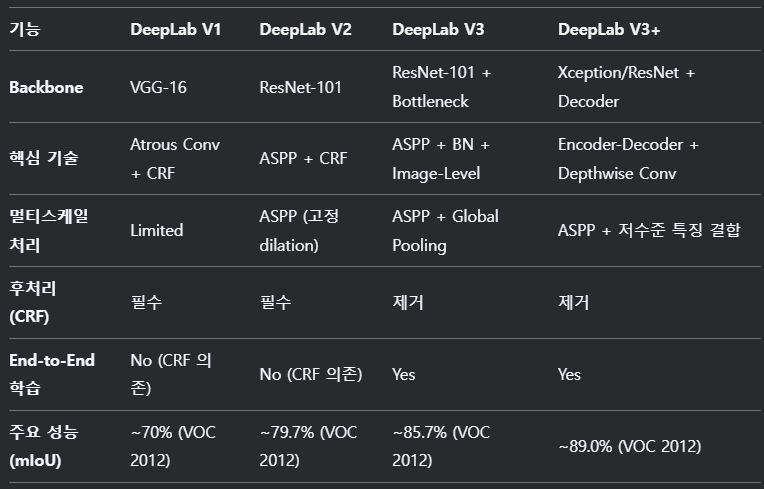
ResNet-101의 마지막 몇 층에 atrous convolution을 추가해서 수용 영역을 확장함.
이 과정에서 stride를 줄이고 atrous convolution으로 이미지 해상도를 유지함
2. ASPP 모듈
network의 마지막 부분에 병렬로 atrous convolution 블록을 추가하여 다양한 스케일의 특징을 추출
3. CRF 후처리
segmentation 결과를 개선하기 위해서 CRF를 사용함. 이로 인해 픽셀간의 경계를 더 세밀하게 만듬
한계점
CRF의 계산비용으로 인해서 속도가 저하
복잡한 객체의 경계 처리나 고밀도 객체를 분리하는데는 어렵다.
deeplab v2의 동작 과정
1. 입력을 받고 backbone network에 적합한 형식으로 정규화 한다.
2. ResNet-101을 사용하여 특징을 수출
여기에서 ResNet-101의 마지막 몇개의 layer에 atrous convolution을 적용해서 receptive filed를 확장
이렇게 하면 다운 샘플링을 최소화하며, 더 많은 문맥 정보를 가진 feature map을 얻을수있다.
3. ASPP를 사용한다.
여러 dilation rate로 처리한 결과를 병합하여 하나의 feature map을 얻는다.
4. 최종 feature map 처리
ASPP로 생성된 feature map은 1x1 convolution으로 채널 수 를 축소한다.
이렇게 하여, 각 픽셀에 대한 클래스 점수를 계산하기 위한 준비를 함
5. upsampling을 사용하여 feature map을 입력 image와 동일한 크기로 만들어준다. ( 즉 ,복원 )
주로 Bilinear upsampling을 사용
6. CRF를 사용하여 후처리
import tensorflow as tf
from tensorflow.keras.layers import Conv2D, MaxPooling2D, Input, Conv2DTranspose, Softmax, Concatenate, BatchNormalization, Add, ReLU
from tensorflow.keras.models import Model
from tensorflow.keras.utils import plot_model

def build_resnet101_backbone(input_shape):
    """
    ResNet-101 백본을 직접 구현하는 함수
    입력: 이미지 입력 크기 (input_shape)
    출력: ResNet-101의 마지막 convolution feature map
    """
    inputs = Input(shape=input_shape)

    # 초기 컨볼루션 블록
    x = Conv2D(64, (7, 7), strides=2, padding='same', activation='relu')(inputs)
    x = MaxPooling2D((3, 3), strides=2, padding='same')(x)

    def residual_block(x, filters, dilation_rate=1):
        shortcut = x
        if x.shape[-1] != filters * 4:
            shortcut = Conv2D(filters * 4, (1, 1), padding='same', activation='relu')(shortcut)

        x = Conv2D(filters, (1, 1), padding='same', activation='relu')(x)
        x = Conv2D(filters, (3, 3), padding='same', dilation_rate=dilation_rate, activation='relu')(x)
        x = Conv2D(filters * 4, (1, 1), padding='same', activation='relu')(x)

        x = Add()([shortcut, x])  # 채널 수가 맞아야 Add 가능
        x = ReLU()(x)
        return x


    for _ in range(23):  # ResNet-101의 Conv4 블록 반복 횟수
        x = residual_block(x, 256)

    return Model(inputs=inputs, outputs=x, name="ResNet101_Backbone")

def atrous_spatial_pyramid_pooling(x):
    """
    ASPP (Atrous Spatial Pyramid Pooling) 모듈 구현
    """
    atrous_rates = [6, 12, 18, 24]
    atrous_layers = [Conv2D(256, (3, 3), padding='same', dilation_rate=rate, activation='relu')(x) for rate in atrous_rates]

    # 1x1 convolution 추가
    conv_1x1 = Conv2D(256, (1, 1), activation='relu', padding='same')(x)

    # Global Average Pooling
    global_avg = tf.reduce_mean(x, axis=[1, 2], keepdims=True)
    global_avg = Conv2D(256, (1, 1), activation='relu', padding='same')(global_avg)
    global_avg = tf.image.resize(global_avg, (x.shape[1], x.shape[2]))

    # ASPP 결과 합치기
    x = Concatenate()([conv_1x1] + atrous_layers + [global_avg])
    x = Conv2D(256, (1, 1), activation='relu', padding='same')(x)
    return x

def build_deeplabv2_resnet101(input_shape=(512, 512, 3), num_classes=21):
    """
    DeepLab v2 모델을 ResNet-101 백본을 기반으로 구축하는 함수
    입력: 이미지 크기 (input_shape), 클래스 수 (num_classes)
    출력: DeepLab v2 모델
    """
    base_model = build_resnet101_backbone(input_shape)

    # ResNet-101의 마지막 convolution feature map 가져오기
    x = base_model.output

    # ASPP 적용
    x = atrous_spatial_pyramid_pooling(x)

    # Upsampling (8배 upsampling)
    x = Conv2DTranspose(num_classes, kernel_size=8, strides=8, padding='same')(x)
    x = Softmax()(x)

    model = Model(inputs=base_model.input, outputs=x)

    # 모델 구조 시각화 (Graphviz 사용)
    plot_model(model, to_file='deeplabv2_resnet101.png', show_shapes=True, show_layer_names=True)

    return model

# 모델 생성
model = build_deeplabv2_resnet101()

# 모델 구조 출력
model.summary()